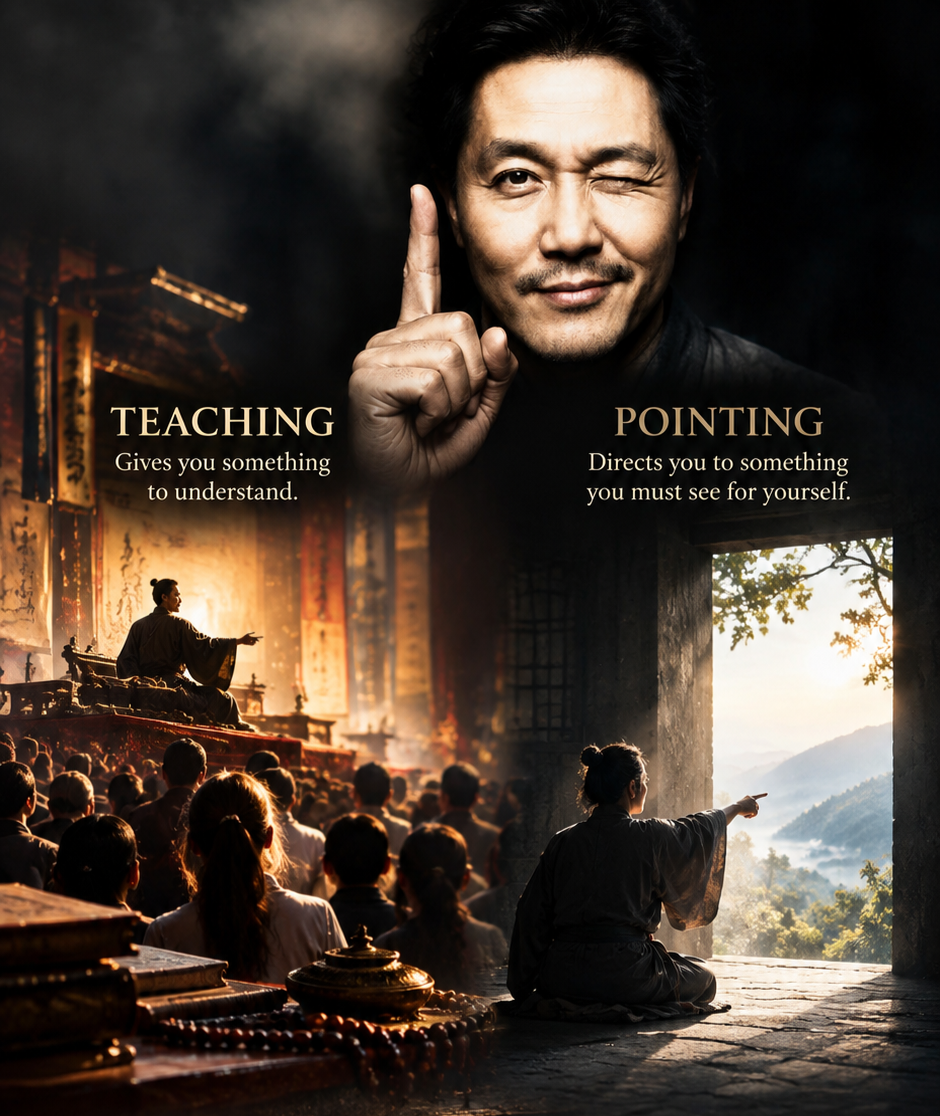
In Seon, there is a distinction between those who stand outside the gate and those who have already entered.
Teaching is what those outside the gate usually want to hear.
Pointing is what those who have entered the gate truly seek.
The two may appear similar on the surface, but they lead in completely different directions.
When people outside the gate receive teachings, they often begin to admire the person who taught them. They compare one teaching with another, search for a higher teaching, follow more teachers, and continually look for a better way.
The teaching itself becomes the object of their search.
But when a Seon master points, there is nothing new to collect.
The master simply points to what is already here.
And when the person suddenly sees for themselves what has been pointed to, there is nowhere else to go.
Everything is resolved there.
Teaching can be grand and elaborate.
So elaborate, in fact, that its brilliance can hide the very truth it is meant to reveal.
Pointing can be so simple and light that it appears almost insignificant.
Yet precisely where the finger points, there is something utterly unexpected:
This.
There is a gate without boundaries.
It cannot be directly taught through any language in the world, because no words can carry you across that gate.
Yet it can be pointed to.
It can be described.
And it can be recognized.
But the truth itself is not something to be understood through thought.
It can only be verified directly.
This is why Seon does not ask you to understand the truth.
It asks you to see for yourself.
There is a subtle difference between teaching and pointing, just as there is between knowledge and wisdom.
Knowledge can be acquired from another.
Wisdom begins when what has been pointed to is directly seen for oneself.
The teacher can speak.
The teacher can point.
But no one can see it for you.
The finger is not the moon.
Do not remain outside the gate collecting teachings.
Look where the finger is pointing.
Then see.
-Nim-
PS. A Note on the Korean Words
In Korean, 가르침 (gareuchim) means teaching, while 가리킴 (garikim) means pointing.
They sound remarkably similar, which is why even Koreans can sometimes confuse them.
But their meanings point in completely different directions.
가르침 gives you something to understand.
가리킴 points to something you must see for yourself.
Much like the difference between knowledge and wisdom.